 Escritas.org

Some Poems
Biography
Videos
Books
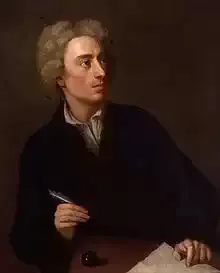
Alexander Pope (21 May 1688 – 30 May 1744)
Pope was born in London to Alexander Pope (senior, a linen merchant) and Edith Pope (née Turner), who were both Catholics. Pope's education was affected by the penal law in force at the time upholding the status of the established Church of England, which banned Catholics from teaching on pain of perpetual imprisonment. Pope was taught to read by his aunt, then went to Twyford School in about 1698–9. He then went to two Catholic schools in
London. Such schools, while illegal, were tolerated in some areas.
In 1700, his family moved to a small estate in Binfield, Berkshire, close to the royal Windsor Forest. This was due to strong anti-Catholic sentiment and a statute preventing Catholics from living within 10 miles (16 km) of either
London or Westminster. Pope would later describe the countryside around the house in his poem Windsor Forest. Pope's formal education ended at this time, and from then on he mostly educated himself by reading the works of
classical writers such as the satirists Horace and Juvenal, the epic poets Homer and Virgil, as well as English authors like Geoffrey Chaucer, William Shakespeare and John Dryden. He also studied many languages and read
works by English, French, Italian, Latin, and Greek poets. After five years of study, Pope came into contact with figures from the London literary society such as William Wycherley, William Congreve, Samuel Garth, William
Trumbull, and William Walsh.
At Binfield, he also began to make many important friends. One of them, John Caryll (the future dedicatee of The Rape of the Lock), was twenty years older than the poet and had made many acquaintances in the London literary
world. He introduced the young Pope to the ageing playwright William Wycherley and to William Walsh, a minor poet, who helped Pope revise his first major work, The Pastorals. He also met the Blount sisters, Teresa and
(his alleged future lover) Martha, both of whom would remain lifelong friends.
From the age of 12, he suffered numerous health problems, such as Pott's disease (a form of tuberculosis that affects the bone) which deformed his body and stunted his growth, leaving him with a severe hunchback. His
tuberculosis infection caused other health problems including respiratory difficulties, high fevers, inflamed eyes, and abdominal pain. He never grew beyond 1.37 metres (4 feet, 6 inches) tall. Pope was already removed from
society because he was Catholic; his poor health only alienated him further.
Although he never married, he had many female friends whom he wrote witty letters. He did have one alleged lover, his lifelong friend, Martha Blount.
Alexander Pope became a Freemason (a mortal sin in the Catholic Church).
He was a member of the Premier Grand Lodge of England, and also belonged to the Spalding Gentlemen's Society.
In May, 1709, Pope's Pastorals was published in the sixth part of Tonson's Poetical Miscellanies. This brought instant fame to Pope. This was followed by An Essay on Criticism published in May 1711 , which was equally well
received.
Around 1711, Pope made friends with Tory writers John Gay, Jonathan Swift, Thomas Parnell and John Arbuthnot, who together formed the satirical Scriblerus Club. The aim of the club was to satirise ignorance and pedantry in
the form of the fictional scholar Martinus Scriblerus. He also made friends with Whig writers Joseph Addison and Richard Steele. In March of 1713, Windsor Forest was published and was a well known success.
Pope's next well known poem was The Rape of the Lock; first published in 1712, with a revised version published in 1714. This is sometimes considered Pope's most popular poem because it was a mock-heroic epic, written to
make fun of a high society quarrel between Arabella Fermor (the "Belinda" of the poem) and Lord Petre, who had snipped a lock of hair from her head without her permission. In his poem he treats his characters in an epic style;
when the Baron steals her hair and she tries to get it back, it flies into the air and turns into a star.
During Pope's friendship with Joseph Addison, he contributed to Addison's play Cato as well as writing for The Guardian and The Spectator. Around this time he began the work of translating the Iliad, which was a painstaking
process - publication began in 1715 and did not end until 1720.
In 1714, the political situation worsened with the death of Queen Anne and the disputed succession between the Hanoverians and the Jacobites, leading to the attempted Jacobite Rebellion of 1715. Though Pope as a Catholic
might be expected to have supported the Jacobites, because of his religious and political affiliations, according to Maynard Mack, "where Pope himself stood on these matters can probably never be confidently known". These
events led to an immediate downturn in the fortunes of the Tories, and Pope's friend, Henry St John, 1st Viscount Bolingbroke fled to France.
The money made from his translation of Homer allowed Pope to move to a
villa at Twickenham in 1719, where he created his now famous grotto and
gardens. Pope decorated the grotto with alabaster, marbles, and ores such
as mundic and crystals. He also used Cornish diamonds, stalactites, spars,
snakestones and spongestone. Here and there in the grotto he placed
mirrors, expensive embellishments for the time. A camera obscura was
installed to delight his visitors, of whom there were many. The serendipitous
discovery of a spring during its excavations enabled the subterranean retreat
to be filled with the relaxing sound of trickling water, which would quietly
echo around the chambers. Pope was said to have remarked that: "Were it to
have nymphs as well – it would be complete in everything." Although the
house and gardens have long since been demolished, much of this grotto still
survives. The grotto now lies beneath Radnor House Independent Co-ed
School, and is occasionally opened to the public.
Poetry
An Essay on Criticism was first published anonymously on 15 May 1711.
Pope began writing the poem early in his career and took about three years
to finish it.
At the time the poem was published, the heroic couplet style in which it was
written was a moderately new genre of poetry, and Pope's most ambitious
work. An Essay on Criticism was an attempt to identify and refine his own
positions as a poet and critic. The poem was said to be a response to an
ongoing debate on the question of whether poetry should be natural, or
written according to predetermined artificial rules inherited from the classical
past.
The poem begins with a discussion of the standard rules that govern poetry
by which a critic passes judgment. Pope comments on the classical authors
who dealt with such standards, and the authority that he believed should be
accredited to them. He discusses the laws to which a critic should adhere
while critiquing poetry, and points out that critics serve an important function
in aiding poets with their works, as opposed to the practice of attacking
them.
The final section of An Essay on Criticism discusses the moral qualities and
virtues inherent in the ideal critic, who, Pope claims, is also the ideal man.
Pope's most famous poem is The Rape of the Lock, first published in 1712,
with a revised version published in 1714. A mock-epic, it satirises a
high-society quarrel between Arabella Fermor (the "Belinda" of the poem)
and Lord Petre, who had snipped a lock of hair from her head without her
permission. The satirical style is tempered, however, by a genuine and
almost voyeuristic interest in the "beau-monde" (fashionable world) of
18th-century English society. Critics pay special attention to the fictitious
card game, 'Ombre', that Pope creates for the poem; much time has been
spent trying to reconstruct the rules of the game, and the arcane obscurity of
how it might actually be played reflects the Byzantine nature of 18th-century
high society
Though the Dunciad was first published anonymously in Dublin, its
authorship was not in doubt. As well as Theobald, it pilloried a host of other
"hacks", "scribblers" and "dunces". Mack called its publication "in many ways
the greatest act of folly in Pope's life". Though a masterpiece, "it bore bitter
fruit. It brought the poet in his own time the hostility of its victims and their
sympathizers, who pursued him implacably from then on with a few
damaging truths and a host of slanders and lies...". The threats were
physical too. According to his sister, Pope would never go for a walk without
the company of his Great Dane, Bounce, and a pair of loaded pistols in his
pocket.
In 1731, Pope published his "Epistle to Burlington", on the subject of
architecture, the first of four poems which would later be grouped under the
title Moral Essays (1731–35). In the epistle, Pope ridiculed the bad taste of
the aristocrat "Timon". Pope's enemies claimed he was attacking the Duke of
Chandos and his estate, Cannons. Though the charge was untrue, it did Pope
a great deal of damage.
The Essay on Man is a philosophical poem, written in heroic couplets and
published between 1732 and 1734. Pope intended this poem to be the
centrepiece of a proposed system of ethics that was to be put forth in poetic
form. It was a piece of work that Pope intended to make into a larger work;
however, he did not live to complete it.
The poem is an attempt to "vindicate the ways of God to Man," a variation on Milton's attempt in
Paradise Lost to "justify the ways of God to Man" (1.26). It challenges as
prideful an anthropocentric world-view. The poem is not solely Christian;
however, it makes an assumption that man has fallen and must seek his own
salvation.
It consists of four epistles that are addressed to Lord Bolingbroke. Pope
presents an idea or his view on the Universe; he says that no matter how
imperfect, complex, inscrutable and disturbing the Universe appears to be, it
functions in a rational fashion according to the natural laws. The natural laws
consider the Universe as a whole a perfect work of God. To humans it
appears to be evil and imperfect in many ways; however, Pope points out
that this is due to our limited mindset and limited intellectual capacity. Pope
gets the message across that humans must accept their position in the
"Great Chain of Being" which is at a middle stage between the angels and
the beasts of the world. If we are able to accomplish this then we potentially
could lead happy and virtuous lives.
The poem is an affirmative poem of faith: life seems to be chaotic and
confusing to man when he is in the center of it, but according to Pope it is
really divinely ordered. In Pope's world God exists and is what he centres the
Universe around in order to have an ordered structure. The limited
intelligence of man can only take in tiny portions of this order and can
experience only partial truths, hence man must rely on hope which then
leads into faith. Man must be aware of his existence in the Universe and
what he brings to it, in terms of riches, power and fame. It is man's duty to
strive to be good regardless of other situations: this is the message Pope is
trying to get across to the reader
Later Works
The Imitations of Horace followed (1733–38). These were written in the popular Augustan form of the
"imitation" of a classical poet, not so much a translation of his works as an
updating with contemporary references. Pope used the model of Horace to
satirise life under George II, especially what he regarded as the widespread
corruption tainting the country under Walpole's influence and the poor
quality of the court's artistic taste.
Pope also added a wholly original poem, An Epistle to Doctor Arbuthnot, as
an introduction to the "Imitations". It reviews his own literary career and
includes the famous portraits of Lord Hervey ("Sporus") and Addison
("Atticus"). In 1738 he wrote the Universal Prayer.
After 1738, Pope wrote little. He toyed with the idea of composing a patriotic
epic in blank verse called Brutus, but only the opening lines survive. His
major work in these years was revising and expanding his masterpiece The
Dunciad. Book Four appeared in 1742, and a complete revision of the whole
poem in the following year. In this version, Pope replaced the "hero", Lewis
Theobald, with the poet laureate Colley Cibber as "king of
dunces". By now Pope's health, which had never been good, was failing, and
he died in his villa surrounded by friends on 30 May 1744. On the previous
day, 29 May 1744, Pope called for a priest and received the Last Rites of the
Catholic Church. He lies buried in the nave of the Church of St Mary the
Virgin in Twickenham.
Reception
However, by the mid-18th century new fashions in poetry started to emerge.
A decade after Pope's death, Joseph Warton claimed that Pope's style of
poetry was not the most excellent form of the art. The Romantic movement
that rose to prominence in early 19th-century England was more ambivalent
towards his work. Though Lord Byron identified Pope as one of his chief
influences (believing his scathing satire of contemporary English literature
English Bards and Scotch Reviewers to be a continuance of Pope's tradition),
William Wordsworth found Pope's style fundamentally too decadent to
represent the human condition truly.
In the 20th century an effort to revive Pope's reputation began and was
successful. Pope's work was now found to be full of references to the people
and places of his time and these aided individuals' understanding of the past.
The postwar period stressed the power of Pope's poetry and recognised that
Pope's immersion in Christian and Biblical culture gave great depth to his
poetry. Maynard Mack thought very highly of Pope's poetry. He argued that
Pope's humane moral vision demanded as much respect as his technical
excellence. In the years 1953–1967 the production of the definitive
Twickenham edition of Pope's poems was published in ten volumes.
Modern Reception
Modern criticism of Pope focuses on the man, his circumstances and
motivations, prompted by theoretical perspectives such as Marxism,
feminism and other forms of post-structuralism. Brean Hammond focuses on
Pope's singular achievement in making an independent living solely from his
writing. Laura Brown (1985) adopts a Marxist approach and accuses Pope of
being an apologist for the oppressive upper classes. Hammond (1986) has
studied Pope's work from the perspectives of cultural materialism and new
historicism. Along Hammond's lines, Raymond Williams explains art as a set
of practices influenced by broad cultural factors rather than simply the vague
ideas of genius alone.
In 'Politics and Poetics of Transgression' (1985) Peter Stallybrass and Allon
White charge that Pope drew upon the low culture which he despised in order
to produce his own 'high art'. They assert Pope was implicated in the very
material he was attempting to exclude, not dissimilar to observations made
in Pope's time.
Feminists have also criticised Pope's works. Ellen Pollak's 'The Poetics of
Sexual Myth' (1985) argues that Pope followed an anti-feminist tradition,
that regarded women as inferior to men both intellectually and physically.
Carolyn Williams contends that a crisis in the male role during the 18th
century in Britain impacted Pope and his writing.
Alexander Pope, Rediscovering A Genius
Alexander Pope-brief background
alexander pope mcq | mcq on alexander pope | alexander pope essay on man mcq | essay on criticism
Alexander Pope | E@6 Videopedia | TES | Kalyani Vallath | NTA NET, K SET, G SET, WB SET, GATE, J SET
Alexander Pope Quotes You Need To Know Today | Top Alexander Pope Quotes
Alexander Pope Ode on Solitude poem with text
"Ode on Solitude" by Alexander Pope (read by Tom O'Bedlam)
10 Key Facts about Alexander Pope every UGC NET Aspirant must know
Alexander Pope, The Rape of the Lock
Alexander Pope - Tarihe Damga Vuran 10 Sözü
Alexander Pope
Alexander Pope THE RAPE OF THE LOCK poem analysis—Hungry Judges & Social Satire—18th Century Poetry
Alexander Pope- brief introduction
Ugc Net English Literature -Neo Classical Literature -Alexander Pope (QUOTES AND IMP POINTS)
Eternal Sunshine Of The Spotless Mind - Poetry - Alexander Pope
Alexander pope II Biography & Works II Explained in Hindi II Augustan age/The age of Pope
Alexander Pope Lesson
DSSSB/HSSC TGT 2023 | DSSSB/HSSC English Classes | Alexander Pope Complete works
Alexander Pope as a Literary Critic || Essay on Criticism & Essay on Man Explained with Quotations !
Alexander Pope THE DUNCIAD poem reading | Book 4 | The Triumph of Dullness | 18th century poetry
Alexander Pope | Alexander Pope as a representative poet | Alexander Pope as a satirist | Notes
Alexander Pope in hindi
🔵 Sound and Sense Poem by Alexander Pope - Summary Analysis Reading - Sound and Sense Alexander Pope
Rape of the lock : Alexander Pope in Hindi summary
From An Essay On Criticism by Alexander Pope. Summary and line by line analysis.
Alexander pope biography in hindi (augustan age /neo classical age )
The Iliad - Book I - Homer (Alexander Pope translation)
Alexander Pope- neoclassical age
Jonathan Swift and Alexander Pope Life History and Majors Literary Works for BCS Preliminary Exam
13- The Age of Neoclassicism: Alexander Pope ١٣- عصر الكلاسيكية الجديدة: ألكسندر بوب
Fraiser Recites Quote by Alexander Pope
Alexander Pope | Biography of Alexander Pope | Alexander Pope Life and Works | Pope's Heroic Couplet
Notable Quotes By Alexander Pope, The Author Of The Dunciad | Life Changing
Alexander Pope as Critic - I
Someone Dead Ruined My Life… Again.
The Rape of the Lock by Alexander Pope - Summary with details in Hindi
Alexander Pope
An Essay on Criticism by Alexander Pope [Full Audiobook]
Alexander Pope, "The Rape of the Lock"
Alexander Pope Lines on Dulness | Eighteenth Century poetry reading | Alexander Pope poem reading
Alexander Pope: Ode on Solitude
History of English Literature | Neo-Classical AGE | AUGUSTAN PERIOD | Age of POPE
Alexander Pope: Life and Works
NC Poetry Out Loud 2010 - "Ode On Solitude" by Alexander Pope
Essay on criticism by Alexander pope in hindi
Eloisa to Abelard by Alexander Pope
"Sound and Sense from Essay on Criticism" by Alexander Pope (read by Tom O'Bedlam)
Ode On Solitude by Alexander Pope in Odia
WILLIAM HAZLITT essay on Literary Envy | Romanticism, William Wordsworth, & Alexander Pope’s Poetry
Alexander Pope The Rape of the Lock | POEM ANALYSIS | Mock-Epic Genre, Scale, Antithesis, & Zeugma