 Escritas.org


Some Poems
Biography
Images
Videos
Books
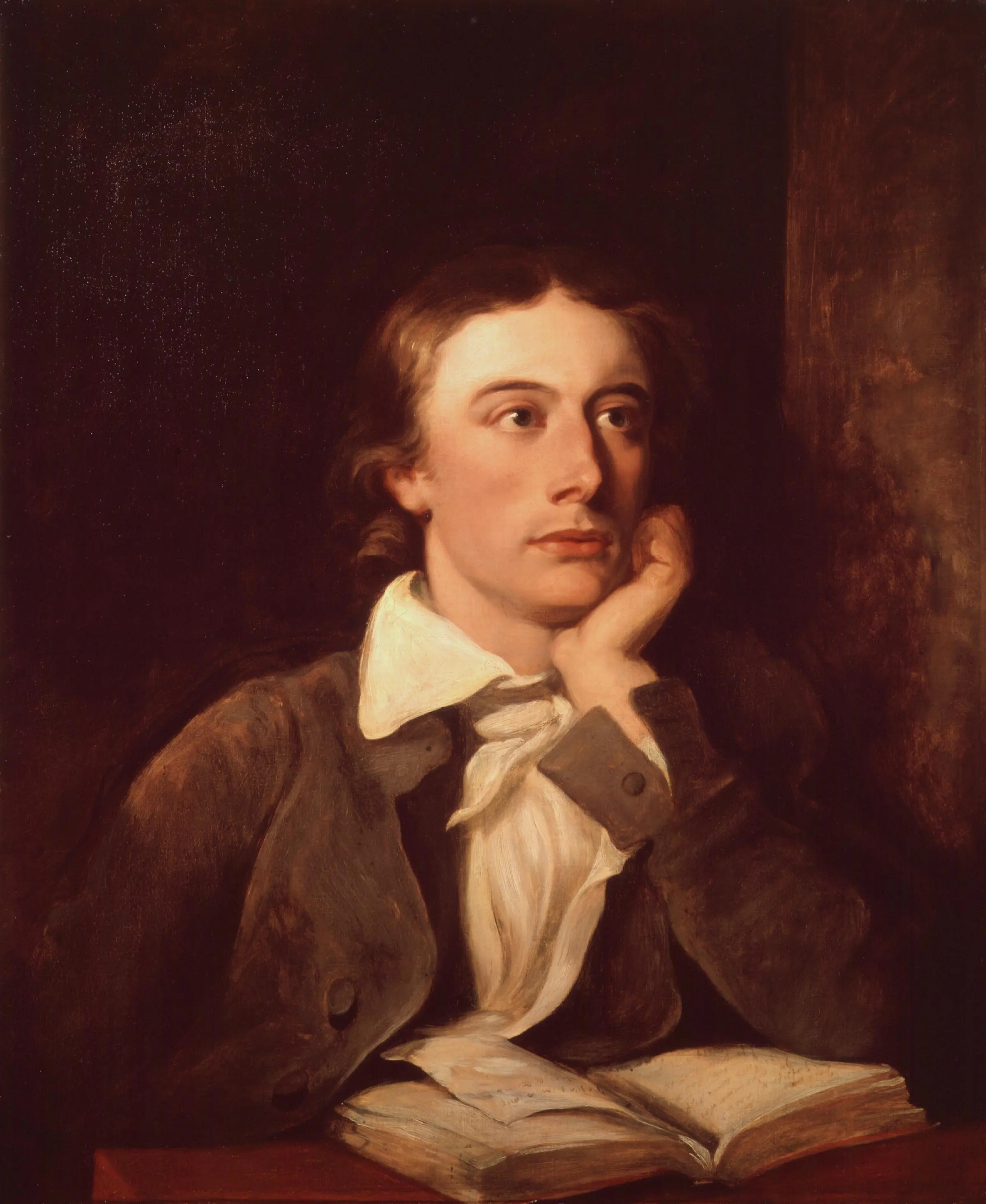
John Keats (31 October 1795 – 23 February 1821)
John Keats was an English Romantic poet. He was one of the main figures of
the second generation of romantic poets along with Lord
Byron and Percy Bysshe
Shelley, despite his work only having been in publication for four years
before his death.
Although his poems were not generally well received by critics during his life,
his reputation grew after his death, so that by the end of the 19th century he
had become one of the most beloved of all English poets. He had a
significant influence on a diverse range of later poets and writers. Jorge Luis
Borges stated that his first encounter with Keats was the most significant
literary experience of his life.
The poetry of Keats is characterized by sensual imagery, most notably in the
series of odes. Today his poems and letters are some of the most popular
and most analyzed in English literature.
Biography
Early Life
John Keats was born on 31 October 1795 to Thomas and Frances Jennings
Keats. Keats and his family seemed to have marked his birthday on 29
October, however baptism records give the birth date as the 31st. He was
the eldest of four surviving children; George (1797–1841), Thomas
(1799–1818) and Frances Mary "Fanny" (1803–1889). Another son was lost
in infancy. John was born in central London although there is no clear
evidence of the exact location. His father first worked as a hostler at the
stables attached to the Swan and Hoop inn, an establishment he later
managed and where the growing family lived for some years. Keats believed
that he was born at the inn, a birthplace of humble origins, but there is no
evidence to support this. The Keats at the Globe pub now occupies the site, a
few yards from modern day Moorgate station. He was baptised at St
Botolph-without-Bishopsgate and sent to a local dame school as a child.
His parents were unable to afford Eton or Harrow, so in the summer of 1803
he was sent to board at John Clarke's school in Enfield, close to his
grandparents' house. The small school had a liberal, progressive outlook and
a progressive curriculum more modern than the larger, more prestigious
schools. In the family atmosphere at Clarke's, Keats developed an interest in
classics and history which would stay with him throughout his short life. The
www.PoemHunter.com - The World's Poetry Archive
headmaster's son, Charles Cowden Clarke, would become an important
influence, mentor and friend, introducing Keats to Renaissance literature
including Tasso, Spenser and Chapman's translations. Keats is described as a
volatile character "always in extremes", given to indolence and fighting.
However at 13 he began focusing his energy towards reading and study,
winning his first academic prize in midsummer 1809.
In April 1804, when Keats was eight, his father died after fracturing his skull
falling from his horse when returning from visiting John and his brother
George at the school. Thomas died intestate. Frances remarried two months
later, but left her new husband soon afterwards, and the four children went
to live with their grandmother, Alice Jennings, in the village of Edmonton. In
March 1810, when Keats was 14, his mother died of tuberculosis leaving the
children in the custody of their grandmother. She appointed two guardians,
Richard Abbey and John Sandell, to take care of them. That autumn, Keats
left Clarke's school to apprentice with Thomas Hammond, a surgeon and
apothecary, neighbour and doctor of the Jennings family, and lodged in the
attic above the surgery at 7 Church Street until 1813. Cowden Clarke, who
remained a close friend of Keats, described this as "the most placid time in
Keats's life".
Early Career
From 1814 Keats had two bequests held in trust for him until his 21st
birthday: £800 willed by his grandfather John Jennings (about £34,000 in
today's money) and a portion of his mother's legacy, £8000 (about £340,000
today), to be equally divided between her living children. It seems he was
not told of either, since he never applied for any of the money. Historically,
blame has often been laid on Abbey as legal guardian, but he may well have
also been unaware. William Walton, solicitor for Keats's mother and
grandmother, definitely did know and had a duty of care to relay the
information to Keats. It seems he did not. The money would have made a
critical difference to the poet's expectations. Money was always a great
concern and difficulty for him, as he struggled to stay out of debt and make
his way in the world independently.
On First Looking into Chapman's Homer
Much have I travell'd in the realms of gold,
And many goodly states and kingdoms seen;
Round many western islands have I been
Which bards in fealty to Apollo hold.
Oft of one wide expanse had I been told
That deep-browed Homer ruled as his demesne;
Yet did I never breathe its pure serene
Till I heard Chapman speak out loud and bold:
Then felt I like some watcher of the skies
When a new planet swims into his ken;
Or like stout Cortez when with eagle eyes
He star'd at the Pacific — and all his men
Look'd at each other with a wild surmise —
Silent, upon a peak in Darien.
“”
The sonnet "On First Looking into Chapman's Homer"
October 1816
Having finished his apprenticeship with Hammond, Keats registered as a
medical student at Guy's Hospital (now part of King's College London) and
began there in October 1815. Within a month of starting, he was accepted as
a dresser at the hospital, assisting surgeons during operations, the
equivalent of a junior house surgeon today. It was a significant promotion
marking a distinct aptitude for medicine, the position bringing increased
responsibility and workload. His long and expensive medical training with
Hammond and at Guy's Hospital led his family to assume this would be his
lifelong career, assuring financial security, and it seems that at this point
Keats had a genuine desire to become a doctor. Keats lodged near the
hospital at 28 St Thomas's Street in Southwark, with other medical students.
www.PoemHunter.com - The World's Poetry Archive
Keats's training took up increasing amounts of his writing time and he felt
increasingly ambivalent about his medical career. He felt presented with a
stark choice. Keats's first surviving poem, An Imitation of Spenser, had been
written in 1814, when Keats was 19. Now, strongly drawn by ambition,
inspired by fellow poets such as Leigh Hunt and Byron, and beleaguered by
family financial crises, he suffered periods of depression. His brother George
wrote that John "feared that he should never be a poet, & if he was not he
would destroy himself". In 1816, Keats received his apothecary's licence
which made him eligible to practise as an apothecary, physician and surgeon,
but before the end of the year he announced to his guardian that he had
resolved to be a poet, not a surgeon.
Though he continued his work and training at Guy's, Keats was devoting
increasing time to the study of literature, experimenting with verse forms,
particularly at this time sonnets. In May 1816, Leigh Hunt agreed to publish
the sonnet O Solitude in his magazine The Examiner, a leading liberal
magazine of the day. It is the first appearance of Keats's poems in print and
Charles Cowden Clarke refers to it as his friend's red letter day, first proof
that Keats's ambitions were valid. In the summer of that year he went with
Clarke to the seaside town of Margate to write. There he began Calidore and
initiated the era of his great letter writing. On his return to London he took
lodgings at 8 Dean Street, Southwark and braced himself for further study in
order to become a member of the Royal College of Surgeons.
In October, Clarke introduced Keats to the influential Hunt, a close friend of
Byron and Shelley. Five months later Poems, the first volume of Keats verse,
was published, which included "I stood tiptoe" and "Sleep and Poetry", both
poems strongly influenced by Hunt. It was a critical failure, arousing little
interest, although Reynolds reviewed it favourably in The Champion. Clarke
commented that the book "might have emerged in Timbuctoo". Keats's
publishers, Charles and James Ollier, felt ashamed of the book. Keats
immediately changed publishers to Taylor and Hessey on Fleet Street. Unlike
Olliers, Keats's new publishers were enthusiastic about his work. Within a
month of the publication of Poems they were planning a new Keats volume
and had paid him an advance. Hessey became a steady friend to Keats and
made the company's rooms available for young writers to meet. Their
publishing lists would come to include Coleridge, Hazlitt, Clare, Hogg, Carlyle
and Lamb.
At Taylor and Hessey Keats met their Eton-educated lawyer Richard
Woodhouse. Woodhouse, who advised the publishers on literary as well as
legal matters, was deeply impressed by Poems. Though he noted that Keats
could be "wayward, trembling, easily daunted", Woodhouse was convinced of
Keats's genius, a poet to support as he became one of England's greatest
writers. Soon after they met, the two became close friends and Woodhouse
started to collect Keatsiana, documenting as much as he could about Keats's
poetry, an archive that survives as one of the main sources of information on
Keats's work.Motion casts him as Boswell to Keats' Johnson, ceaselessly
promoting the writer's work, fighting his corner, spurring his poetry on to
greater heights. At the end, Woodhouse would be one of the few people to
accompany Keats to Gravesend to embark on his final trip to Rome.
In spite of the bad reviews of Poems, Hunt published the essay Three Young
Poets (Shelley, Keats and Reynolds) and the sonnet On First Looking into
Chapman's Homer, foreseeing great things to come. He introduced Keats to
many prominent men in his circle, including editor of The Times Thomas
Barnes, writer Charles Lamb, conductor Vincent Novello and poet John
Hamilton Reynolds, who would become a close friend. He was also meeting
William Hazlitt regularly, a powerful literary figure of the day. It was a
decisive turning point for Keats, establishing him in the public eye as a figure
in, what Hunt termed 'a new school of poetry'. At this time Keats wrote to his
friend Bailey: "I am certain of nothing but the holiness of the Heart's
affections and the truth of the imagination. What imagination seizes as
Beauty must be truth". This would eventually transmute into the concluding
lines of Ode on a Grecian Urn: "'Beauty is truth, truth beauty' – that is all /
you know on earth, and all ye need to know". In early December, under the
www.PoemHunter.com - The World's Poetry Archive
heady influence of his artistic friends, Keats told Abbey that he had decided
to give up medicine in favour of poetry, to Abbey's fury. Keats had spent a
great deal on his medical training and had made several large loans that he
could ill afford.
Having left his training at the hospital, suffering from a succession of colds,
and unhappy with living in damp rooms in London, Keats moved with his
brothers into rooms at 1 Well Walk in the village of Hampstead in April 1817.
Both John and George nursed their brother Tom, who was suffering from
tuberculosis. The house was close to Hunt and others from his circle in
Hampstead, as well as to Coleridge, respected elder of the first wave of
Romantic poets, Around this time he was introduced to Charles Wentworth
Dilke, James Rice and Benjamin Bailey.
In June 1818, Keats began a walking tour of Scotland, Ireland and the Lake
District with his friend Charles Armitage Brown. Keats' brother George and
his wife Georgina accompanied them as far as Lancaster and then continued
to Liverpool, from where the couple would emigrate to America. They lived in
Ohio and Louisville, Kentucky until 1841 when George's investments failed.
Like Keats' other brother, they died penniless and racked by tuberculosis.
There would be no effective treatment for the disease until 1921. In July,
while on the Isle of Mull, Keats caught a bad cold and "was too thin and
fevered to proceed on the journey". After his return south in August, Keats
continued to nurse Tom, exposing himself to infection. Some biographers
suggest that this is when tuberculosis, his "family disease", first took hold.
Tom Keats died on 1 December 1818.
Wentworth Place
John Keats moved to the newly built Wentworth Place, owned by his friend
Charles Armitage Brown. It was also on the edge of Hampstead Heath, ten
minutes walk south of his old home in Well Walk. The winter of 1818–19,
though a difficult period for the poet, marked the beginning of his annus
mirabilis in which he wrote his most mature work. He had been inspired by a
series of recent lectures by Hazlitt on English poets and poetic identity and
had also met Wordsworth.
Keats may have seemed to his friends to be living on comfortable means, but
in reality he was borrowing regularly from Abbey and his friends.
He composed five of his six great odes at Wentworth Place in April and May
and, although it is debated in which order they were written, "Ode to Psyche"
opened the published series. According to Brown, "Ode to a Nightingale" was
composed under a plum tree in the garden. Brown wrote, "In the spring of
1819 a nightingale had built her nest near my house. Keats felt a tranquil
and continual joy in her song; and one morning he took his chair from the
breakfast-table to the grass-plot under a plum-tree, where he sat for two or
three hours. When he came into the house, I perceived he had some scraps
of paper in his hand, and these he was quietly thrusting behind the books.
On inquiry, I found those scraps, four or five in number, contained his poetic
feelings on the song of our nightingale." Dilke, co-owner of the house,
strenuously denied the story, printed in Milnes' 1848 biography of Keats,
dismissing it as pure delusion.
My heart aches, and a drowsy numbness pains
My sense, as though of hemlock I had drunk,
Or emptied some dull opiate to the drains
One minute past, and Lethe-wards had sunk:
’Tis not through envy of thy happy lot,
But being too happy in thine happiness,—
That thou, light-winged Dryad of the trees,
In some melodious plot
Of beechen green, and shadows numberless,
Singest of summer in full-throated ease.
“”
First stanza of "Ode to a Nightingale",
www.PoemHunter.com - The World's Poetry Archive
May 1819
"Ode on a Grecian Urn" and "Ode on Melancholy" were inspired by sonnet
forms and probably written after "Ode to a Nightingale". Keats's new and
progressive publishers Taylor and Hessey issued Endymion, which Keats
dedicated to Thomas Chatterton, a work that he termed "a trial of my Powers
of Imagination". It was damned by the critics, giving rise to Byron's quip that
Keats was ultimately "snuffed out by an article", suggesting that he never
truly got over it. A particularly harsh review by John Wilson Croker appeared
in the April 1818 edition of The Quarterly Review. " John Gibson Lockhart
writing in Blackwood's Magazine, described Endymion as "imperturbable
drivelling idiocy". With biting sarcasm, Lockhart advised, "It is a better and a
wiser thing to be a starved apothecary than a starved poet; so back to the
shop Mr John, back to plasters, pills, and ointment boxes ". It was Lockhart
at Blackwoods who coined the defamatory term "the Cockney School" for
Hunt and his circle, which included both Hazlitt and Keats. The dismissal was
as much political as literary, aimed at upstart young writers deemed uncouth
for their lack of education, non-formal rhyming and "low diction". They had
not attended Eton, Harrow or Oxbridge and they were not from the upper
classes.
In 1819, Keats wrote The Eve of St. Agnes, "La Belle Dame sans Merci",
Hyperion, Lamia and Otho (critically damned and not dramatised until 1950).
The poems "Fancy" and "Bards of passion and of mirth" were inspired by the
garden of Wentworth Place. In September, very short of money and in
despair considering taking up journalism or a post as a ship's surgeon, he
approached his publishers with a new book of poems.They were unimpressed
with the collection, finding the presented versions of "Lamia" confusing, and
describing "St Agnes" as having a "sense of pettish disgust" and "a 'Don
Juan' style of mingling up sentiment and sneering" concluding it was "a poem
unfit for ladies". The final volume Keats lived to see, Lamia, Isabella, The Eve
of St. Agnes, and Other Poems, was eventually published in July 1820. It
received greater acclaim than had Endymion or Poems, finding favourable
notices in both The Examiner and Edinburgh Review. It would come to be
recognised as one of the most important poetic works ever published.
Wentworth Place now houses the Keats House museum.
Isabella Jones and Fanny Brawne
Keats befriended Isabella Jones in May 1817, while on holiday in the village
of Bo Peep, near Hastings. She is described as beautiful, talented and widely
read, not of the top flight of society yet financially secure, an enigmatic
figure who would become a part of Keats's circle.Throughout their friendship
Keats never hesitates to own his sexual attraction to her, although they
seem to enjoy circling each other rather than offering commitment. He writes
that he "frequented her rooms" in the winter of 1818–19, and in his letters to
George says that he "warmed with her" and "kissed her". It is unclear how
close they were, but Bate and Gittings suggest the trysts may represent a
sexual initiation for Keats. Jones' greatest significance may be as an
inspiration and steward of Keats's writing. The themes of The Eve of St.
Agnes and The Eve of St Mark may well have been suggested by her, the
lyric Hush, Hush! ["o sweet Isabel"] was about her, and that the first version
of "Bright Star" may have originally been for her. In 1821, Jones was one of
the first in England to be notified of Keats's death.
Letters and drafts of poems suggest that Keats first met Frances (Fanny)
Brawne between September and November 1818. It is likely that the
18-year-old Brawne visited the Dilke family at Wentworth Place before she
lived there. She was born in the hamlet of West End (now in the district of
West Hampstead), on 9 August 1800. Like Keats's grandfather, her
grandfather kept a London inn, and both lost several family members to
tuberculosis. She shared her first name with both Keats's sister and mother,
and had a talent for dress-making and languages as well as a natural
theatrical bent. During November 1818 she developed an intimacy with
Keats, but it was shadowed by the illness of Tom Keats, whom John was
nursing through this period.
www.PoemHunter.com - The World's Poetry Archive
On 3 April 1819, Brawne and her widowed mother moved into the other half
of Dilke's Wentworth Place, and Keats and Brawne were able to see each
other every day. Keats began to lend Brawne books, such as Dante's Inferno,
and they would read together. He gave her the love sonnet "Bright Star"
(perhaps revised for her) as a declaration. It was a work in progress which
he continued at until the last months of his life, and the poem came to be
associated with their relationship. "All his desires were concentrated on
Fanny". From this point there is no further documented mention of Isabella
Jones. Sometime before the end of June, he arrived at some sort of
understanding with Brawne, far from a formal engagement as he still had too
little to offer, with no prospects and financial stricture. Keats endured great
conflict knowing his expectations as a struggling poet in increasingly hard
straits would preclude marriage to Brawne. Their love remained
unconsummated; jealousy for his 'star' began to gnaw at him. Darkness,
disease and depression surrounded him, reflected in poems such as The Eve
of St. Agnes and "La Belle Dame sans Merci" where love and death both
stalk. "I have two luxuries to brood over in my walks;" he wrote to her,
"...your loveliness, and the hour of my death".
In one of his many hundreds of notes and letters, Keats wrote to Brawne on
13 October 1819: "My love has made me selfish. I cannot exist without you –
I am forgetful of every thing but seeing you again – my Life seems to stop
there – I see no further. You have absorb'd me. I have a sensation at the
present moment as though I was dissolving – I should be exquisitely
miserable without the hope of soon seeing you ... I have been astonished
that Men could die Martyrs for religion – I have shudder'd at it – I shudder
no more – I could be martyr'd for my Religion – Love is my religion – I could
die for that – I could die for you."
Tuberculosis took hold and he was advised by his doctors to move to a
warmer climate. In September 1820 Keats left for Rome knowing he would
probably never see Brawne again. After leaving he felt unable to write to her
or read her letters, although he did correspond with her mother. He died
there five months later. None of Brawne's letters to Keats survive; he
requested that her letters be destroyed after his death.
It took a month for the news of his death to reach London, after which
Brawne stayed in mourning for six years. In 1833, more than 12 years after
his death, she married and went on to have three children; she outlived
Keats by more than 40 years. The 2009 film Bright Star, written and directed
by Jane Campion, focuses on Keats' relationship with Fanny Brawne.
Last months: Rome
During 1820 Keats displayed increasingly serious symptoms of tuberculosis,
suffering two lung haemorrhages in the first few days of February. He lost
large amounts of blood and was bled further by the attending physician.
Hunt nursed him in London for much of the following summer. At the
suggestion of his doctors, he agreed to move to Italy with his friend Joseph
Severn. On 13 September, they left for Gravesend and four days later
boarded the sailing brig "Maria Crowther", where he made the final revisions
of "Bright Star". The journey was a minor catastrophe: storms broke out
followed by a dead calm that slowed the ship’s progress. When they finally
docked in Naples, the ship was held in quarantine for ten days due to a
suspected outbreak of cholera in Britain. Keats reached Rome on November
14, by which time any hope of the warmer climate he sought had
disappeared.
Keats wrote his last letter on November 30, 1820 to Charles Armitage
Brown; "Tis the most difficult thing in the world to me to write a letter. My
stomach continues so bad, that I feel it worse on opening any book – yet I
am much better than I was in Quarantine. Then I am afraid to encounter the
proing and conning of any thing interesting to me in England. I have an
habitual feeling of my real life having past, and that I am leading a
posthumous existence".
www.PoemHunter.com - The World's Poetry Archive
He moved into a villa on the Spanish Steps, today the Keats-Shelley
Memorial House museum. Despite care from Severn and Dr. James Clark, his
health rapidly deteriorated, and the medical attention he received may have
hastened his death. In November 1820, Clark declared that the source of his
illness was "mental exertion" and the source was largely situated in his
stomach. Clark eventually diagnosed consumption (tuberculosis) and placed
Keats on a starvation diet of an anchovy and a piece of bread a day, hoping
to reduce the blood flow to his stomach. He bled the poet; a standard
treatment of the day, but probably contributing significantly to Keats's
weakness. Keats's friend Brown writes: "They could have used opium in
small doses, and Keats had asked Severn to buy a bottle of opium when they
were setting off on their voyage. What Severn didn't realise was that Keats
saw it as a possible resource if he wanted to commit suicide. He tried to get
the bottle from Severn on the voyage but Severn wouldn't let him have it.
Then in Rome he tried again ... Severn was in such a quandary he didn't
know what to do, so in the end he went to the doctor who took it away. As a
result Keats went through dreadful agonies with nothing to ease the pain at
all."
On 10 December, Severn returned from an early walk and woke Keats.
Immediately, the poet began to cough and then vomit blood, about two
cupfuls. Clark was summoned and promptly bled him. The loss of blood
dizzied and confused Keats. When Clark left, Keats got out of his bed,
stumbled around the rooms, and said to Severn, "This day shall be my last."
Severn feared a suicide attempt and hid any sharp object he could find as
well as the laudanum prescribed by Clarke. Keats was delirious for the rest of
the day, until a violent haemorrhage and bleeding weakened him into calm.
Over the next nine days he suffered five severe haemorrhages and continued
bleedings by Clark. The doctor visited constantly and put him on a strict diet,
mostly fish. Keats begged for food, believing he was being starved. Clark
held no hope of recovery and admitted as much to Keats. The poet's
thoughts turned again to suicide and he begged Severn for the laudanum, at
first appealing to Severn's self-interest, but he was refused. Keats became
angry; he raged at Severn for keeping him alive against his will. When
Severn, not trusting himself, gave the bottle to Clark, Keats turned on the
doctor asking "How long is this posthumous life of mine to last?"
Death
The first months of 1821 marked a slow and steady decline into the final
stage of tuberculosis. Keats was coughing up blood and covered in sweat.
Severn nursed him devotedly and observed in a letter how Keats would
sometimes cry upon waking to find himself still alive. Severn writes,
"Keats raves till I am in a complete tremble for him...about four, the
approaches of death came on. [Keats said] 'Severn—I—lift me up—I am
dying—I shall die easy; don't be frightened—be firm, and thank God it has
come.' I lifted him up in my arms. The phlegm seem'd boiling in his throat,
and increased until eleven, when he gradually sank into death, so quiet, that
I still thought he slept."
John Keats died on 23 February 1821 and was buried in the Protestant
Cemetery, Rome. His last request was to be placed under an unnamed
tombstone which contained only the words (in pentameter), "Here lies one
whose name was writ in water." Severn and Brown erected the stone, which
under a relief of a lyre with broken strings, contains the epitaph:
"This Grave / contains all that was Mortal / of a / Young English Poet / Who /
on his Death Bed, in the Bitterness of his Heart / at the Malicious Power of
his Enemies / Desired / these Words to be / engraven on his Tomb Stone: /
Here lies One / Whose Name was writ in Water. 24 February 1821"
There is a discrepancy of one day between the official date of death and that
on the gravestone. Severn and Brown added their lines to the stone in
protest at the critical reception of Keats's work. Hunt blamed his death on
the Quarterly Review's scathing attack of "Endymion". As Byron quipped in
his narrative poem Don Juan;
www.PoemHunter.com - The World's Poetry Archive
'Tis strange the mind, that very fiery particle
Should let itself be snuffed out by an article.
(canto 2, stanza 60)
Seven weeks after the funeral Shelley memorialised Keats in his poem
Adonaïs. Clark saw to the planting of daisies on the grave, saying that Keats
would have wished it. For public health reasons, the Italian health authorities
burned the furniture in Keats's room, scraped the walls, made new windows,
doors and flooring. The ashes of Shelley, one of Keats’s most fervent
champions, are buried in the cemetery and Joseph Severn is buried next to
Keats. Describing the site today, Marsh wrote, "In the old part of the
graveyard, barely a field when Keats was buried here, there are now
umbrella pines, myrtle shrubs, roses, and carpets of wild violets".
Reception
When Keats died at 25, he had been writing poetry seriously for only about
six years, from 1814 until the summer of 1820; and publishing for only four.
In his lifetime, sales of Keats's three volumes of poetry probably amounted
to only 200 copies. His first poem, the sonnet O Solitude appeared in the
Examiner in May 1816, while his collection Lamia, Isabella, The Eve of St.
Agnes and other poems was published in July 1820 before his last visit to
Rome. The compression of his poetic apprenticeship and maturity into so
short a time is just one remarkable aspect of Keats's work.
Although prolific during his short career, and now one of the most studied
and admired British poets, his reputation rests on a small body of work,
centred on the Odes, and only in the creative outpouring of the last years of
his short life was he able to express the inner intensity for which he has been
lauded since his death. Keats was convinced that he had made no mark in
his lifetime. Aware that he was dying, he wrote to Fanny Brawne in February
1820, "I have left no immortal work behind me – nothing to make my friends
proud of my memory – but I have lov'd the principle of beauty in all things,
and if I had had time I would have made myself remember'd."
Keats's ability and talent was acknowledged by several influential
contemporary allies such as Shelley and Hunt.
His admirers praised him for thinking "on his pulses", for having developed a
style which was more heavily loaded with sensualities, more gorgeous in its
effects, more voluptuously alive than any poet who had come before him:
'loading every rift with ore'. Shelley often corresponded with Keats in Rome,
and loudly declared that Keats's death had been brought on by bad reviews
in the Quarterly Review. Seven weeks after the funeral he wrote Adonaïs, a
despairing elegy, stating that Keats' early death was a personal and public
tragedy:
The loveliest and the last,
The bloom, whose petals nipped before they blew
Died on the promise of the fruit.
Although Keats wrote that "if poetry comes not as naturally as the Leaves to
a tree it had better not come at all", poetry did not come easy to him, his
work the fruit of a deliberate and prolonged classical self-education. He may
have possessed an innate poetic sensibility but his early works were clearly
those of a young man learning his craft. His first attempts at verse were
often vague, languorously narcotic and lacking a clear eye. His poetic sense
was based on the conventional tastes of his friend Charles Cowden Clarke,
who first introduced him to the classics, and also came from the predilections
of Hunt's Examiner, which Keats read as a boy. Hunt scorned the Augustan
or 'French' school, dominated by Pope, and attacked the earlier Romantic
poets Wordsworth and Coleridge, now in their forties, as unsophisticated,
obscure and crude writers. Indeed, during Keats's few years as a published
poet, the reputation of the older Romantic school was at its lowest ebb.
Keats came to echo these sentiments in his work, identifying himself with a
'new school' for a time, somewhat alienating him from Wordsworth, Coleridge and Byron and providing the basis from the scathing attacks from
Blackwoods and The Quarterly.
Season of mists and mellow fruitfulness
Close bosom-friend of the maturing sun
Conspiring with him how to load and bless
With fruit the vines that round the thatch-eaves run;
To bend with apples the moss'd cottage-trees,
And fill all fruit with ripeness to the core;
To swell the gourd, and plump the hazel shells
With a sweet kernel; to set budding more,
And still more, later flowers for the bees,
Until they think warm days will never cease,
For Summer has o'er-brimm'd their clammy cells.
“”
First stanza of "To Autumn",
September 1819
By the time of his death, Keats had therefore been associated with the taints
of both old and new schools: the obscurity of the first wave Romantics and
the uneducated affectation of Hunt's "Cockney School". Keats's posthumous
reputation mixed the reviewers' caricature of the simplistic bumbler with the
image of the hyper-sensitive genius killed by high feeling, which Shelley later
portrayed.
The Victorian sense of poetry as the work of indulgence and luxuriant fancy
offered a schema into which Keats was posthumously fitted. Marked as the
standard bearer of sensory writing, his reputation grew steadily and
remarkably. His work had the full support of the influential Cambridge
Apostles, whose members included the young Tennyson,
later a popular Poet Laureate who came to regard Keats as the greatest poet
of the 19th century. In 1848, twenty-seven years after Keats's death,
Richard Monckton Milnes wrote the first full biography, which helped place
Keats within the canon of English literature. The Pre-Raphaelite Brotherhood,
including Millais and Rossetti, were inspired by Keats, and painted scenes
from his poems including "The Eve of St. Agnes", "Isabella" and "La Belle
Dame sans Merci", lush, arresting and popular images which remain closely
associated with Keats's work.
In 1882, Swinburn
e wrote in the Encyclopædia Britannica that "the Ode to a Nightingale,
[is] one of the final masterpieces of human work in all time and for all ages".
In the twentieth century, Keats remained the muse of poets such as Wilfred
Owen, who kept his death date as a day of mourning, Yeats and
T. S.
Eliot. Critic Helen Vendler stated the odes "are a group of works in
which the English language find ultimate embodiment". Bate declared of To
Autumn: "Each generation has found it one of the most nearly perfect poems
in English" and M. R. Ridley claimed the ode "is the most serenely flawless
poem in our language."
The largest collection of the letters, manuscripts, and other papers of Keats
is in the Houghton Library at Harvard University. Other collections of material
are archived at the British Library, Keats House, Hampstead, the
Keats-Shelley Memorial House in Rome and the Pierpont Morgan Library in
New York. Since 1998 the British Keats-Shelley Memorial Association have
annually awarded a prize for romantic poetry.
Biographical Controversy
None of Keats' biographies were written by people who had known him.
www.PoemHunter.com - The World's Poetry Archive
Shortly after his death, his publishers announced they would speedily publish
The memoirs and remains of John Keats but his friends refused to cooperate
and argued with each other to the extent that the project was abandoned.
Leigh Hunt's Lord Byron and some of his Contemporaries (1828) gives the
first biographical account, strongly emphasising Keats's supposedly humble
origins, a misconception which still continues. Given that he was becoming a
significant figure within artistic circles, a succession of other publications
followed, including anthologies of his many notes, chapters and letters.
However, early accounts often gave contradictory or heavily biased versions
of events and were subject to dispute. His friends Brown, Severn, Dilke,
Shelley and his guardian Richard Abbey, his publisher Taylor, Fanny Brawne
and many others issued posthumous commentary on Keats's life. These early
writings coloured all subsequent biography and have become embedded in a
body of Keats legend.
Shelley promoted Keats as someone whose achievement could not be
separated from agony, who was 'spiritualised' by his decline and too
fine-tuned to endure the harshness of life; the consumptive, suffering image
popularly held today. The first full biography was published in 1848 by
Richard Monckton Milnes. Landmark Keats biographers since include Sidney
Colvin, Robert Gittings, Walter Jackson Bate and Andrew Motion. The
idealised image of the heroic romantic poet who battled poverty and died
young was inflated by the late arrival of an authoritative biography and the
lack of an accurate likeness. Most of the surviving portraits of Keats were
painted after his death, and those who knew him held that they did not
succeed in capturing his unique quality and intensity.
Letters
Keats' letters were first published in 1848 and 1878. During the 19th
century, critics deemed them unworthy of attention, distractions from his
poetic works. During the 20th century they became almost as admired and
studied as his poetry, and are highly regarded within the canon of English
literary correspondence. T. S. Eliot described them as "certainly the most
notable and most important ever written by any English poet." Keats spent a
great deal of time considering poetry itself, its constructs and impacts,
displaying a deep interest unusual amongst his milieu who were more easily
distracted by metaphysics or politics, fashions or science. Eliot wrote of
Keats's conclusions; "There is hardly one statement of Keats' about poetry
which ... will not be found to be true, and what is more, true for greater and
more mature poetry than anything Keats ever wrote."
Few of Keats's letters from the period before he joined his literary circle are
extant. From spring 1817, however, there is a rich record of his prolific and
impressive skills as letter writer.Keats and his friends, poets, critics,
novelists, and editors wrote to each other daily, and Keats' ideas are bound
up in the ordinary, his day-to-day missives sharing news, parody and social
commentary. They glitter with humour and critical intelligence.Born of an
"unself-conscious stream of consciousness," they are impulsive, full of
awareness of his own nature and his weak spots. When his brother George
went to America, Keats wrote to him in great detail, the body of letters
becoming "the real diary" and self-revelation of Keats's life, as well as
containing an exposition of his philosophy, and the first drafts of poems
containing some of Keats's finest writing and thought. Gittings describes
them as akin to a "spiritual journal" not written for a specific other, so much
as for synthesis.
Keats also reflected on the background and composition of his poetry, and
specific letters often coincide with or anticipate the poems they describe. In
February to May 1819 he produced many of his finest letters". Writing to his
brother George, Keats explored the idea of the world as "the vale of
Soul-making", anticipating the great odes that he would write some months
later. In the letters, Keats coined ideas such as the Mansion of Many
Apartments and the Chameleon Poet, concepts that came to gain common
currency and capture the public imagination, despite only making single
appearances as phrases in his correspondence. The poetical mind, Keats
argued:
www.PoemHunter.com - The World's Poetry Archive
has no self – it is every thing and nothing – It has no character – it enjoys
light and shade;... What shocks the virtuous philosopher, delights the
camelion [chameleon] Poet. It does no harm from its relish of the dark side
of things any more than from its taste for the bright one; because they both
end in speculation. A Poet is the most unpoetical of any thing in existence;
because he has no Identity – he is continually in for – and filling some other
Body – The Sun, the Moon, the Sea and Men and Women who are creatures
of impulse are poetical and have about them an unchangeable attribute – the
poet has none; no identity – he is certainly the most unpoetical of all God's
Creatures.
He used the term Negative capability to discuss the state in which we are
"capable of being in uncertainties, Mysteries, doubts without any irritable
reaching after fact & reason ...[Being] content with half knowledge" where
one trusts in the heart's perceptions. He wrote later: "I am certain of nothing
but the holiness of the Heart's affections and the truth of Imagination – What
the imagination seizes as Beauty must be truth – whether it existed before or
not – for I have the same Idea of all our Passions as of Love they are all in
their sublime, creative of essential Beauty" again and again turning to the
question of what it means to be a poet. "My Imagination is a Monastery and I
am its Monk", Keats notes to Shelley. In September 1819, Keats wrote to
Reynolds "How beautiful the season is now – How fine the air. A temperate
sharpness about it ... I never lik'd the stubbled fields as much as now – Aye,
better than the chilly green of spring. Somehow the stubble plain looks warm
– in the same way as some pictures look warm – this struck me so much in
my Sunday's walk that I composed upon it". The final stanza of his last great
ode: "To Autumn" runs:
Where are the songs of Spring? Ay, where are they?
Think not of them, thou hast thy music too,-
While barred clouds bloom the soft-dying day,
And touch the stubble-plains with rosy hue;
Later, To Autumn became one of the most highly regarded poems in the
English language.
There are areas of his life and daily routine that Keats does not describe. He
mentions little about his childhood or his financial straits and is seemingly
embarrassed to discuss them. There is a total absence of any reference to
his parents. In his last year, as his health deteriorated, his concerns often
gave way to despair and morbid obsessions. The publications of letters to
Fanny Brawne in 1870 focused on this period and emphasised this tragic
aspect, giving rise to widespread criticism at the time.
Works:
Addressed to Haydon (1816) text
Addressed to the Same (1816) text
After dark vapours have oppressed our plains (1817)
As from the darkening gloom a silver dove (1814)
Asleep! O sleep a little while, white pearl! text
A Song About Myself
Bards of Passion and of Mirth text
Before he went to live with owls and bats (1817?)
Bright star, would I were steadfast as thou art (1819)
Calidore: A Fragment (1816)
The Day Is Gone, And All Its Sweets Are Gone
Dedication. To Leigh Hunt, Esq.
A Dream, After Reading Dante's Episode Of Paolo And Francesca text
A Draught of Sunshine
Endymion: A Poetic Romance (1817)
Epistle to John Hamilton Reynolds
Epistle to My Brother George
First Love
The Eve of Saint Mark
The Eve of St. Agnes (1819) text
www.PoemHunter.com - The World's Poetry Archive
The Fall of Hyperion: A Dream (1819)
Fancy (poem)
Fill for me a brimming bowl (1814) text
Fragment of an Ode to Maia
Give me women, wine, and snuff (1815 or 1816)
God of the golden bow (1816 or 1817)
The Gothic looks solemn (1817)
Had I a man's fair form, then might my sighs (1815 or 1816)
Hadst thou liv’d in days of old (1816)
Happy is England! I could be content (1816)
Hither, hither, love (1817 or 1818)
How many bards gild the lapses of time (1816)
The Human Seasons
Hymn To Apollo
Hyperion (1818)
I am as brisk (1816)
I had a dove
I stood tip-toe upon a little hill (1816)
If By Dull Rhymes Our English Must Be Chain'd
Imitation of Spenser (1814) text
In Drear-Nighted December
Isabella or The Pot of Basil (1818) text
Keen, fitful gusts are whisp’ring here and there (1816)
La Belle Dame sans Merci (1819) text
Lamia (1819)
Lines Written on 29 May, the Anniversary of Charles’s Restoration, on
Hearing the Bells Ringing (1814 or 1815)
Lines on Seeing a Lock of Milton's Hair
Lines on The Mermaid Tavern
Meg Merrilies
Modern Love (Keats)
O Blush Not So!
O come, dearest Emma! the rose is full blown (1815)
O grant that like to Peter I (1817?)
O Solitude! if I must with thee dwell (1815 or 1816)
Ode (Keats)
Ode on a Grecian Urn (1819) text
Ode on Indolence (1819)
Ode on Melancholy (1819) text
Ode to a Nightingale (1819) text
Ode to Apollo (1815)
Ode to Fanny
Ode to Psyche (1819)
Oh Chatterton! how very sad thy fate (1815)
Oh! how I love, on a fair summer's eve (1816)
Old Meg (1818)
On a Leander Which Miss Reynolds, My Kind Friend, Gave Me (1817)
On Death text
On Fame text
On First Looking into Chapman's Homer (1816) text
On Leaving Some Friends at an Early Hour (1816)
On Peace (1814) text
On Receiving a Curious Shell, and a Copy of Verses, from the Same Ladies
(1815)
On Receiving a Laurel Crown from Leigh Hunt (1816 or 1817)
On Seeing the Elgin Marbles (1817)
On Sitting Down to Read King Lear Once Again
On the Grasshopper and Cricket (1816)
On the Sea (1817) text
On The Story of Rimini (1817)
On The Sonnet
The Poet (a fragment)
A Prophecy - To George Keats in America
Robin Hood. To A Friend
Sharing Eve's Apple
Sleep and Poetry (1816)
A Song of Opposites
www.PoemHunter.com - The World's Poetry Archive
Specimen of an Induction to a Poem (1816)
Staffa
Stay, ruby breasted warbler, stay (1814)
Stanzas
Think not of it, sweet one, so (1817)
This Living Hand
This pleasant tale is like a little copse (1817)
To —
To a Cat
To a Friend Who Sent Me Some Roses (1816)
To a Lady seen for a few Moments at Vauxhall
To A Young Lady Who Sent Me A Laurel Crown (1816 or 1817)
To Ailsa Rock
To Autumn (1819) text
To Lord Byron (1814) text
To Charles Cowden Clarke (1816)
To Fanny
To G.A.W. (Georgiana Augusta Wylie) (1816)
To George Felton Mathew (1815)
To Georgiana Augusta Wylie
To Haydon
To Haydon with a Sonnet Written on Seeing the Elgin Marbles (1817)
To Homer
To Hope (1815)
To John Hamilton Reynolds
To Kosciusko (1816)
To Leigh Hunt, Esq. (1817)
To My Brother George (epistle) (1816)
To My Brother George (sonnet) (1816)
To My Brothers (1816)
To one who has been long in city pent (1816)
To Sleep
To Solitude
To Some Ladies (1815)
To the Ladies Who Saw Me Crown’d (1816 or 1817)
To the Nile
Two Sonnets on Fame
Unfelt, unheard, unseen (1817)
When I have fears that I may cease to be (1818) text
Where Be Ye Going, You Devon Maid?
Where's the Poet?
Why did I laugh tonight?
Woman! when I behold thee flippant, vain (1815 or 1816)
Written in Disgust of Vulgar Superstition (1816)
Written on a Blank Space
Written on a Summer Evening
Written on the Day that Mr Leigh Hunt Left Prison (1815)
Written Upon the Top of Ben Nevis
You say you love; but with a voice (1817 or 1818)
www.PoemHunter.com - The World's Poetry Archive
When I Have Fears – John Keats (Powerful Life Poetry)
John Keats documentary
How to Read the Poetry of John Keats
John Keats- Ode to a Nightingale
The death of John Keats and his early reputation | 10-Minute Talks | The British Academy
John Keats | life and Works Romantic Age in hindi
An Introduction to John Keats
THE LOTUS by Toru Dutt || Summary in kannada. #englishliterature #englishpoem #ignouenglish
English Literature | John Keats: life and works
The Day is Gone by John Keats — Poetry Reading | Spoken Verse
John Keats - Bright Star (love poems) | Poetry reading with text
The Cockney Romantics: John Keats and his Friends
Poems 1817 by John KEATS read by Peter Tucker | Full Audio Book
Poetry and Immortality: John Keats' 'Ode to a Nightingale' - Professor Belinda Jack
Poetry: "Ode to a Nightingale" by John Keats (read by Michael Sheen)
A Thing Of Beauty by John Keats - Poetry Reading
John Keats
Six Odes of John Keats | In-Depth Summary & Analysis
Ode to a Nightingale | John Keats - Line by Line Explanation
To Autumn | John Keats - Line by Line Explanation
John Keats: Places, patterns, and poetical purposes
"John Keats: His Life And Death"- Abridged, 1973
John Keats
Keats's Ode to a Nightingale
John Keats - I Cannot Exist Without You (Love Letter to Fanny Brawne, 13 October 1819)
JOHN KEATS: What is Negative Capability? Explanation, Analysis & Example from John Keats’ poem Lamia
Musical World Map
🔵 John Keats To Autumn by John Keats - Analysis, Explanation and Reading - To Autumn by John Keats
Musical Map of Europe (Midi Art)
EMRS TGT PGT English John Keats Complete Revision Class # 4 | English By Aishwarya Puri
Six Odes of John Keats | Ode to a Nightingale
Keats's Ode on Melancholy
John Keats: Selected Poems by John Keats (FULL Audiobook)
Musical Map of Africa (Midi Art)
"When I have fears" by John Keats: Analysis
John KEATS – Une Vie, une Œuvre : L’ardeur (France Culture, 2004)
John Keats, Hyperion
Ode on a Grecian Urn | John Keats - Line by Line Explanation
Analysis / Summary of "Ode To a Nightingale" By John Keats : Romantic Poetry
John Keats as Romantic Poet | Characteristics of Romantic Poetry
"La Belle Dame sans Merci" by John Keats – read by Ben Winshaw
John Keats
Deep Relaxation: Meditation Music and John Keats Poems (soft spoken poetry, asmr)
Letteratura Inglese | John Keats (Londra, 1795 - Roma, 1821): vita e opere
Six Odes of John Keats | Ode on Melancholy
On the Grasshopper and the Cricket By John Keats - English Honeydew Class 8
Bright Star by John Keats - Summary and Line by Line Explanation in Hindi
John Keats :Second Generation Romantic poet
Bright Star by John Keats Summary and Analysis
How John Keats Writes A Poem | Ode On A Grecian Urn